One of the first questions we receive from visitors to our 18th century kitchen is about our Clock Jack, which claims a multitude of names and a very interesting history.
Fire roasted meats generally taste much better than baked meat. Unfortunately, a hot fire also uncomfortably roasted the cook in the process of roasting the meat. Since the Renaissance in prosperous kitchens, various forms of mechanization were used to spare human discomfort.
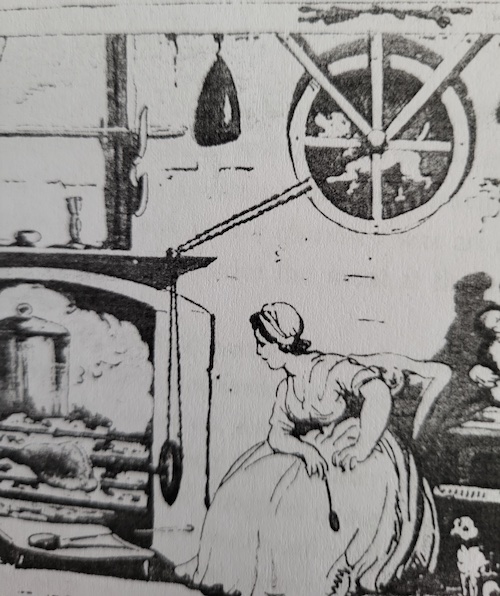
Prior to the era of the machinery you see at Moland House, in the 16th century, dogs were used to generate the tedious rotation with a Dog-Spit which looked like a large hamster wheel, connected to the cooking spit via ropes or chains and pulleys (see sketch). These short legged English pooches called Turnspits (Canis vertigus – literally “dizzy dog”, as Carl Linnaeus dubbed the breed in the 18th c.) were specially bred for this task. Two dogs were generally kept to rotate the spit duties and produce litters (genetic engineering).
Wm and Hannah Penn had a dog-spit at Pennsbury Manor. Franklin’s Pennsylvania Gazette carried ads for Turnspit dogs as well as the associated machinery. More than a century later the Society for the Prevention of Cruelty to Animals was founded. It’s speculated that Welsh Corgis are the Turnspit’s closest living relative.
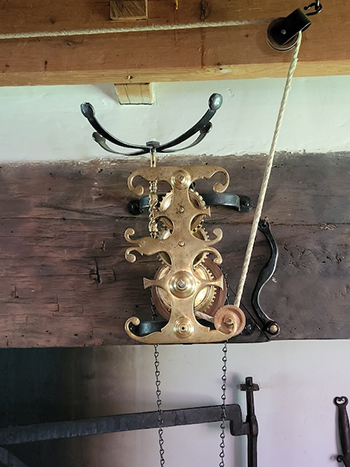
The Clock Jack’s construction involved intricate clockwork mechanisms with gears that must fit precisely for smooth operation (See photo). Some also made a ticking noise, like a clock when in motion. The ratchet system is a crucial component, allowing the weight to be wound without operating the machine. A weight, not pictured due to its distance from the clockwork, provides the power, and a fly regulates the speed. The higher the kitchen ceiling, the better to accommodate a long descent of the Clock Jack’s weights.
Hungry for history,
Christine Mifsud, Curator
September, 2026