Moland House
  • Facebook
  • Twitter
  • Home
  • Moland Park
    • Map of Moland Park
    • The House
    • The Wellhouse
    • Carriage House
    • The Farm
    • Decorative Colonial-Style Garden
      • Moland Park Fans & Volunteers
    • Nature Trail
      • Nature Trail Videos
    • Flag Code
  • History
    • Warwick Township History
      • W.W.H. Davis History of the Encampment
    • The Moland House and American History
      • Thirteen Days in August 1777
        • W.W.H. Davis History of the Encampment
        • Timeline for the Philadelphia Campaign
        • Order of the Main Continental Army
        • His Excellency’s Daily Schedule
        • Council of War
        • Who Was There – The Morning Report August 10-23, 1777
      • Encampment at Moland House in 1777
        • We The People
        • Minutes of Council of General Officers held at Neshamini Camp
        • George Washington
        • Marquis de Lafayette
        • Count Pulaski
        • Light Horse Harry Lee
        • Alexander Hamilton
        • Nathaniel Greene
        • Charles Pinkney
        • James Monroe
        • John Marshall
        • John Laurens
        • Robert Harrison
        • William Woodford
        • George Weedon
        • Anthony Wayne
        • Charles Scott
        • John Muhlenberg
        • Henry Knox
        • Thomas Conway
        • Adam Stephen
        • William Alexander
    • The Moland Family
  • About
    • Warwick Township Historical Society
    • Our Mission
    • Board
      • In Memory of Ken Barlow
    • Interesting Links To Other Websites
    • Directions & Hours
    • Facebook
    • Contact Us
  • Calendar
    • House Tours
    • Directions and Hours
    • Facebook
    • Reenactments
      • Reenactment – 2012 – Sponsors
      • Reenactment – 2012 – Videos
      • Reenactment – 2013 – Patrons
      • Reenactment – 2013 – Photos
      • Reenactment – 2014
        • Reenactment – 2014 – Photos
        • Reenactment – 2014 – Patrons
      • Reenactment 2015
      • Reenactment – 2015 – Photos
      • Reenactment Photos – 2016
      • Reenactment – 2016 – Patrons
      • Reenactment – 2017 – Photos
      • Reenactment – 2017 – Patrons
      • Reenactment – 2018 – Patrons
      • 2019 Reenactment Gallery
      • Reenactment – 2019 – Patrons
      • Reenactment – 2021 – Patrons
      • Reenactment – 2022 – Patrons
      • Reenactment – 2023 – Patrons
      • Reenactment – 2024 – Patrons
    • Spring Tea
    • Flag Day
  • Curator’s Corner
  • Rentals
    • Directions and Hours
    • Contact Us
  • Membership
    • Membership Subscriptions
    • Donate
    • Decorative Colonial-Style Garden
    • Sponsor An Event
    • Volunteer
    • Moland Park Fans & Volunteers

Children’s Bedroom Additions

Posted on January 25, 2026 by Christine Mifsud in Curator's Corner

Two items have recently been added to the second floor children’s bedroom. 
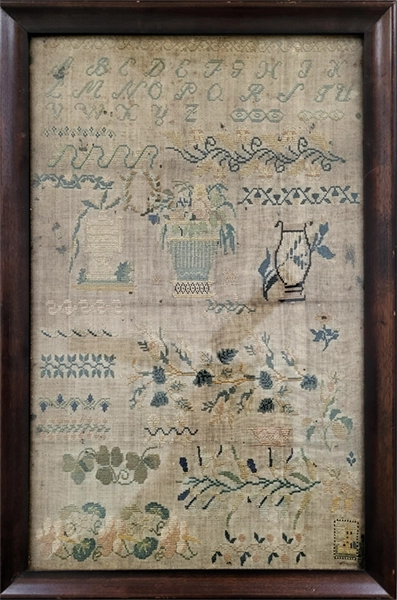
The first, a  12”×21” silk on silk sampler is now hung above the bureau. A Sampler is framed needlework. Young girls,  generally by the age of 7 or 8 would experiment with various hand sewing techniques to demonstrate their education and skills. Our sampler exhibits script style letters, various vines and leaves, urns and repetitive decorative patterns. Simple images such as these would advance to elaborate pictorial designs with verses, flowers and architectural elements to demonstrate talent, virtue and refinement to potential suitors.

Advanced or very skilled needlework would be displayed in the home to showpiece a young woman’s accomplishment, reflecting family status and societal values. Needle skills were needed for mending but the decorative work was a statement of elegance.

Catherine and John Moland had eight children. Three of whom were girls, Hannah, Elizabeth and Grace. Because John Moland was a notable lawyer in both Philadelphia and Bucks county, it is very safe to assume that his daughters would have been taught needle skills to express gentility and social rank.
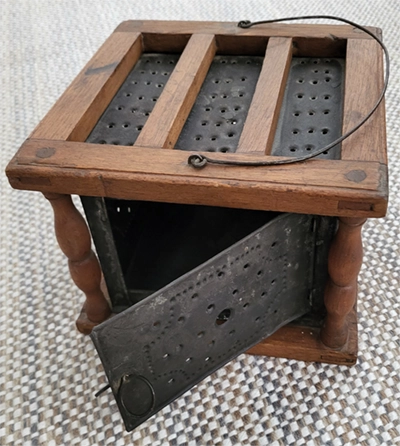
The second addition to the children’s bedroom is a foot warmer or foot stove. Moland House was a summer retreat and working farm. Travel to and from Philadelphia where the family owned a primary residence would have occurred in early spring and late fall to accommodate overseeing the intense labor needed to clear and till land, then to reap the autumn harvests. 

Our foot warmer is a typical design used from the 17th through the early to mid 19th century. It is a wooden box with pierced tin sides and top. A tin door accommodates placing a metal tray or small bucket inside to hold hot embers, charcoal or warm stones. The interior metal “liner” kept the heated coals from igniting the box. The punched or pierced holes allowed heat to radiate upward and outward. Then the wooden frame, with a handle on top protected users from direct heat and made it portable.

Foot warmers were used in carriages, drafty rooms,  parlors or pews. Although commonly used by women and girls, anyone needing to warm their toes would have sought this warming implement.

Admiring Material Memories,
Christine Mifsud,  Curator
January,  2026

Please visit us on Facebook and like us!  We’d love to hear from you. You can also follow us on Twitter!

The Warwick Township Historical Society (WTHS) is a volunteer run,  501(c)3 organization and depends on donations to restore, maintain and operate the Moland House. Your generosity is appreciated!


(c) 2024 Warwick Township Historical Society